12/08/2012

Coeliccia acco Asahina, 1997


Coeliccia acco pair in tandem (Mount Ba Vi, 800m a.s.l.)

Coeliccia is one of my favourite genus of damselflies and Coeliccia acco is, with C. scutellum Laidlaw, 1932 and C. onoi Asahina, 1997 (according to R.A. Dow, the latter is "almost certainly" a junior synonym of Coeliccia cyanomelas Ris, 1912), one of the three species of this genus I have spotted the most in the hills and mountains around Hanoi. 
Coeliccia acco has been described from Cuc Phuong National Park (Ninh Binh Province, northern Vietnam).


The male is easily recognisable with its blue markings / stripes on the synthorax and the yellow-orange last segments and caudal appendages. 

Male in hand : antehumeral stripes are not straight but slightly curved. In dorsal view, they have a parenthesis-like shape.

Last abdominal segments, dorsal view : S9-10 orange tinted dorsally (posterior part of S8 also but not always I think). Appendages are the same color, the superiors a little shorter than the inferiors. 
With my "simple" camera, I cannot go further into the details about this part of the body - but this is not the purpose of this blog anyway.


The mature female has a pale green antehumeral stripe ; sides of the synthorax with two broad yellow-green stripes.
Abdomen brownish dorsally, last segments spotted with dirty yellow.

 Female ovipositing in a small, shallow pool near a stream (Cuc Phuong National Park)

Coelicia acco is known from northern Vietnam and central Laos. 

As I wrote at the beginning of this post, this species is one of the commonest Coeliccia in the Hanoi area, along streams in lowland and mountain forests.

09/08/2012

Indocnemis orang (Förster in Laidlaw, 1907)


Indocnemis orang is a large size and robust build damselfly, frequently spotted hanging around in dark areas along rocky forest streams, in hilly and mountainous régions.  


The male is just gorgeous : prothorax and synthorax deep black, the latter with violet antehumeral elongated patches. Side of synthorax almost entirely black except for a yellow stripe (covering the interpleural suture if I am not wrong), sometimes very reduced (aged individuals?). Ventral side of synthorax also yellow.

Abdomen entirely black (i.e. both ventrally and dorsally) , except the 2 or 3 last segments which bear dorsal pale blue spots.


Caudal appendages :
 Lateral view

Dorsal view


One day I also bumped into an immature male with yellowish - and not violet - patches on the synthorax dorsum.

Immature male. The violet coloration on the dorsum of the synthorax begin to appear

The female has different colors and markings than the male, especially on synthorax : yellow antehumeral stripes, sides with 2 broad yellow stripes. Abdomen black dorsally, the last segments with bluish dorsal spots.


I spotted also another form quite different. I am sure it is a female of I. orang because a male was guarding her as she was ovipositing. This one has pale blue stripes on sides of synthorax instead of yellow ones. Immature form ?


Many time I saw males defending small territories around temporary puddles on rocks and females ovipositing there (in wet moss, mud, rotten wood or leaves, twigs not submerged). Scene of oviposition in the video below.

Female ovipositing in wet moss, on the edge of a small puddle. The male perched nearby, termed "non-contact guarding". Guarding prevents another male from inseminating the female.

Female ovipositing in a twig fell to the ground, above a puddle.

Indocnemis orang is widely distributed in Asia from northeast India to southern China and Malay Peninsula.
In the hills and mountains around Hanoi, this species is a rather common sight in suitable habitat.

31/07/2012

Zygonyx iris Selys, 1869


I spotted many times this large libellulid along swift rocky streams, including those in open and agricultural land, in lowland and montane. The adult males hawk over a limited beat over rivers, generally over a rapid or below a waterfall. But they almost never land! And when they finally perch, they do not tolerate close approach…


Getting a good shot of this species is really difficult; but one day, you will probably bump into a tame individual that will accept what all the other ones have always refused : to be approached less than 1 meter. It happened to me.


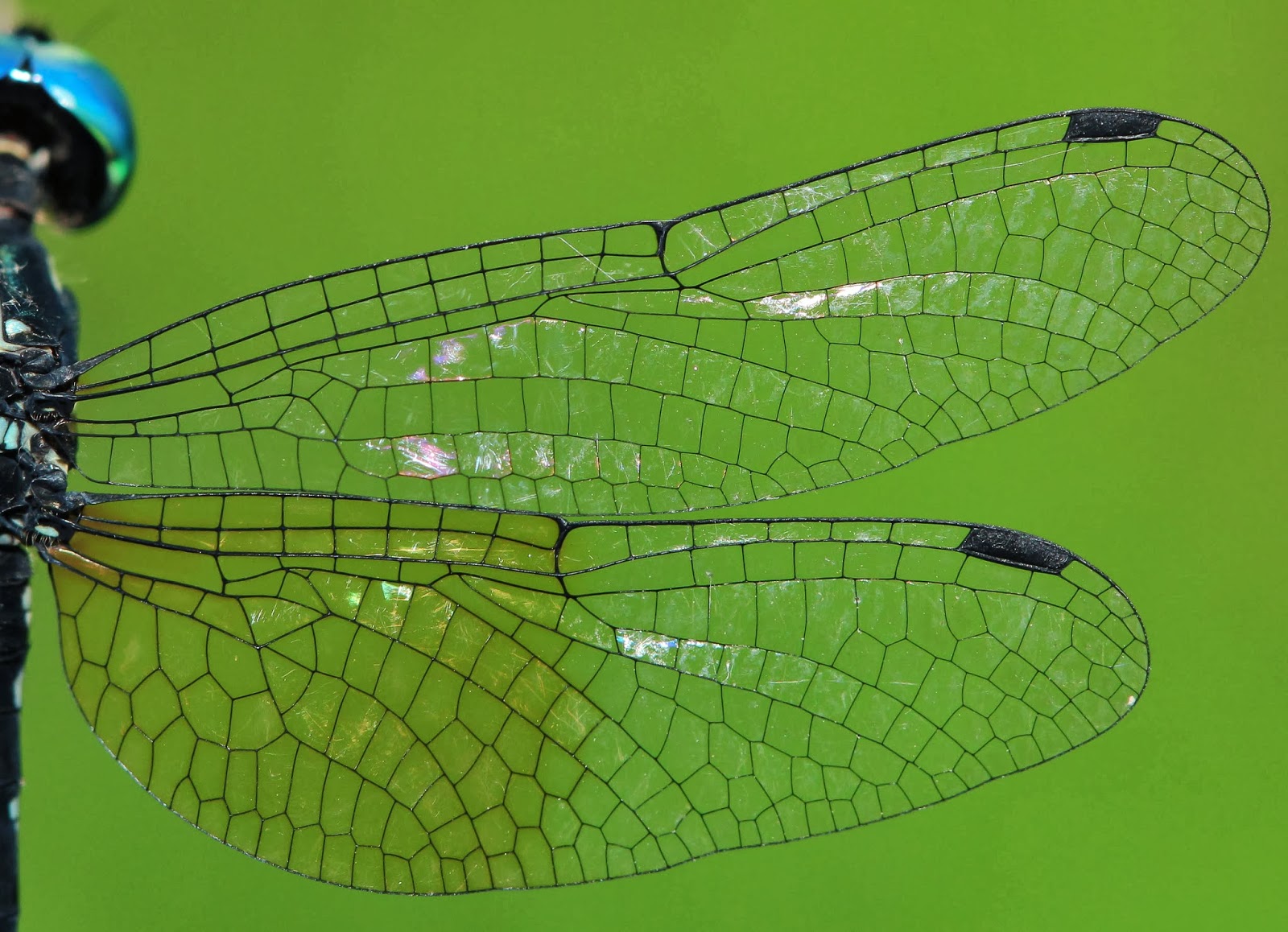
The adult male has broad dark metallic greenish-blue stripes on thorax. Abdomen black, with mid-dorsaI carina finely yellow. Tips of wings enfumed.


Close-up on wings.

Head : frons dark metallic blue

Female (photo below) resembles the male but the lateral yellow markings on abdomen (segments 1 to 3) are more extensive, and the thorax has broad yellow stripes (the immature male also).
Male and female pair over water and travel in tandem for great distances up-stream seeking suitable situations to deposit the eggs. The larvae are adapted, by a flat limpet-like abdomen, to cling to rocks.

  A female ovipositing by dipping her abdomen tip quickly into shallow water. To get some good close-ups of the female, no other solution than to capture her with a net during mating or oviposition. The rest of the time, she is invisible.

A female perched - a rare sight!

Zygonyx iris is a widely distributed species, occurring from northeast India to southern China and south to Borneo. It is a common species over much of its range.


Remarks: Another Zygonyx species occurs in Vietnam . Z. asahinai Matsuki & Saito, 1995 
This species is known from southern and eastern China (Fujian, Guangdong, Guangxi, Zhejiang) and has been recorded in very few localities in northern Vietnam (Mau Son mountain in Lang Son Prov., Tam Dao NP in Vinh Phuc Prov., at least). 

Z. asahinai resembles Z. iris in general appearance but can be readily distinguished from the latter by the following characteristics (from Matsuki & Saito, 1995) :

1. Labium entirely black in aged stage
2. Antehumeral yellow stripe very narrow and short, both infraepisterna darkened entirely
3 ♀wings yellowish orange tinted in the basal one-fourth
4. Different configuration of male accessory genitalia and caudal appendages
5. Different configuration of valvula vulvae


26/07/2012

Tetrathemis platyptera (Selys, 1878)


Tetrathemis platyptera is a very attractive libellulid that I have spotted on a few occasions above stagnant waters, often very small forest pools.


With its emerald-green eyes, bronze-green reflection on thorax, it is a very “photogenic” dragonfly.


The adult male has stunning blue eyes and a metallic green thorax marked broadly with yellowish stripes. 


The wings are hyaline, but the hindwings are faintly tinted with yellow. According to Fraser in The Fauna of British India, including Ceylon and Burma – Odonata (1933), the depth of the colour depends partly on the age of the specimen and partly on the locality, some showing a very intense amber tint, others with no colouring at all, especially teneral specimens.


The abdomen is black, marked with spots (lateral ones from S1 to S4-S5, which decrease in size and length from segment to segment; dorsal basal spot(s) on S7; remaining segments unmarked).


Wings, male. 

 A male caught by a wolf spider.


Female (2 photos below) almost similar in markings to the male, but the abdomen spots are larger, the wings show a much richer and deeper tint of amber.


Her abdomen is also much stouter.
I saw the female briefly, mating and ovipositing immediately after.

Copula.

The female deposits her eggs on branches or leaves overhanging water, from whence the newly hatched larvae drop into their future habitat. One day, I have seen a mass of eggs deposited on a dead branch, 30 cm above the water (watch this scene of oviposition in the video below).

A female on the branch where she will soon begin to oviposit. The male is hovering in close proximity (blue spot in background) to guard the oviposition site and prevent harassment by other males.

                                                                                       Oviposition in action.

Tetrathemis platyptera is widely distributed in tropical and sub-tropical Asia, with records from India, Myanmar, Thailand, Laos, Vietnam, China, Peninsular Malaysia, Java and Sumatra (+Cambodia, Bangladesh?).
According to some authors, this is a rather local species over much of its range, but probably under-recorded.

The place were all these photos were taken : a small pond in degraded forest, at the lower slopes of Tam Dao. Other species breeding there include Coeliccia scutellum, Orolestes selysi, Polycanthagyna erythromelas, Orthetrum triangulare, O. chrysis, Zyxomma petiolatum.