Affichage des articles dont le libellé est Coenagrioniidae. Afficher tous les articles

19/09/2013

Mortonagrion aborense (Laidlaw, 1914)


Hämäläinen (1989) transferred Agriocnemis aborense Laidlaw, 1914 to the genus Mortonagrion Fraser, 1920. He also demonstrated that Agriocnemis binocellata Fraser, 1922, Indagrion gautama Fraser, 1922 and Mortonagrion simile Ris, 1930 are all conspecific with Mortonagrion aborense.

Mortonagrion aborense is a tiny creature (length : 23-24mm), easy to overlook unless you are looking for it. But once you have found one, it is quite easy to lose touch with it in the darkness of shaded ponds because of its swift flight - swift compared to many other pond damselflies I mean. However, the blue end segments of the male help it to stand out. 

Habitat, Hanoi.

 Adult male.


I only spotted adults with yellow-green stripes. But they can also be blue-striped.


A mating pair... found with the help of binoculars !


Shots "in hand" :

Greater part of labrum black; anteclypeus, bases of mandibles and postclypeus greenish ; vertex and occiput black, the latter with rounded postocular spots.
 
Prothorax black on dorsum except the anterior lobe, which is yellow-green.

Thorax black on dorsum, marked with a yellow-green antehumeral stripe on each side; laterally also yellow-green – striped. 
Legs greyish (in fact only coxae, trochanter and femur) - looks like pruinosed. 
S2 with a pair of small oval spots on dorsum; S3-6 black, with lateral stripes nearly confluent across the dorsum at base and again approaching each other subapically on each segment (these markings, except at base, nearly obsolete on S6); S7 with a pair of basal dorsal spots only ; S8 pale bluish ventrolaterally, with a basal blue ring; S9 entirely blue save for an apical row of black spines; segment 10 blue, with its apical border and the mid-dorsal line narrowly black. 

Male, tip of abdomen, lateral.

 Anal appendages black, superiors rather longer than segment 10, curved a little downwards as seen from the side, broad and hollowed out on the inner side, the apex hooked inwards as seen from above ; inferiors considerably shorter, with 2 pairs of spines as seen from above.

Male, tip of abdomen, dorsal.

The female is similar to the male, but the markings on the abdomen are slightly different. 

 Adult female.

Like many species of damselflies (e.g. genus Agriocnemis), tenerals and sub-adults are reddish. 

Teneral male.


Teneral female. 

This is the first record of M. aborense in Vietnam*. I found it... in the suburbs of Hanoi (!), at some small, well shaded ponds hidden among a tiny (one hectare) wooded area – a birding patch in fact. I never expected to find any interesting odonata there, that’s why I never really searched. But one day I had the good idea to scan thoroughly the water surface with the binoculars...

M. aborense is widespread in Asia (from India to Thailand and Laos, and south to Borneo and Sumatra), but quite local in occurrence, found in forest streams, shady ponds and marshes. Although it can sometimes be found outside of forest, it is always in the vicinity of forest and probably depends on some forest cover for its survival.

Its presence in a small wooded patch surrounding by paddy fields and residential areas, in the suburbs of a bustling megacity, is quite amazing.

*In 2013, Tom Kompier found it also at Van Long NR, Cuc Phuong NP and Huu Liên NR. It was surprising that this species had not been recorded elsewhere in Vietnam, given the unlikely location of its discovery. Yet another species that may not be as rare as the scarceness of records suggests!

20/07/2012

Pseudagrion pruinosum (Burmeister, 1839)


During a field trip, as I was scanning a fast-flowing stream with my binoculars, in search of odonata - not birds, I spotted 15 meters away, in a pool, a wheel pair of Pseudagrion pruinosum.
After insemination the pair flew off in tandem, landed on an aquatic plant. The female plunged her abdomen below the water surface. After a while the male released his grasp and the female completely submerged herself while the male perched above on guard. My first sighting of a submerged oviposition !
The female descended 10 centimeters below the surface. I watched the scene 30-35 minutes and left. I would have liked to see the female reappear, but there were so many things to discover around...
Normally, on her reappearance, the pair should reform in tandem.


With his orange face, reddish eyes and pterostigma, greenish abdomen (except the last segments), gray and black thorax, the male is unmistakable.

Considering that odonates abandon their water-breathing gills when they emerge, how do the adults get their oxygen when they return to the depths? According to literature, a thin envelope of air clings to the body and wings which gives them a silvery appearance while they’re under water. Body movements likely force the air in and out of tracheal openings facilitating respiration.


According to Corbet in Dragonflies: Behavior and Ecology of Odonata (1999), this  behavior is almost completely restricted to damselflies (suborder Zygoptera) which all oviposit endophytically- inserting their eggs into plant material instead of just dropping them from the end of the abdomen. The duration of uninterrupted submerged oviposition is often at least 30 minutes and frequently close to an hour. Apparently the record goes to the Marsh Bluet (Enallagma ebrium), a North American species, which is known to go submerged for an incredible five hours! Descending to at least 10 centimeters is common, but some are known to go as far as a meter below the surface!
Some advantages of underwater oviposition include exemption from harassment by males looking to copulate and protecting the eggs from desiccation.

 The male in tandem with the female, just after copulation, searching an oviposition site


In damselflies (suborder Zygoptera) the male clasp the prothorax of the female. In dragonflies (suborder Anisoptera) the male clasp the female back of the head. Those appendages, like lock and key, will only fit into the same species female; that's why they have a great taxonomic value. 

The female crawling down a plant stem to get under the surface, few seconds
before the male release his grasp. 

A completely submerged oviposition. Note the silvery appearance.
Not crystal clear water, but I was a bit responsible I think ;)

Pseudagrion pruinosum has a wide distribution throughout Asia from China to Laos, Cambodia, Vietnam, Thailand, Singapore, Borneo, and throughout Peninsular Malaysia.
It can be found in upland and mountain areas, near open streams or ponds.

In the Hanoi's area, it is a quite common sight along slow-flowing portions (almost still water) of open swift streams where aquatic vegetation can develop.

09/10/2011

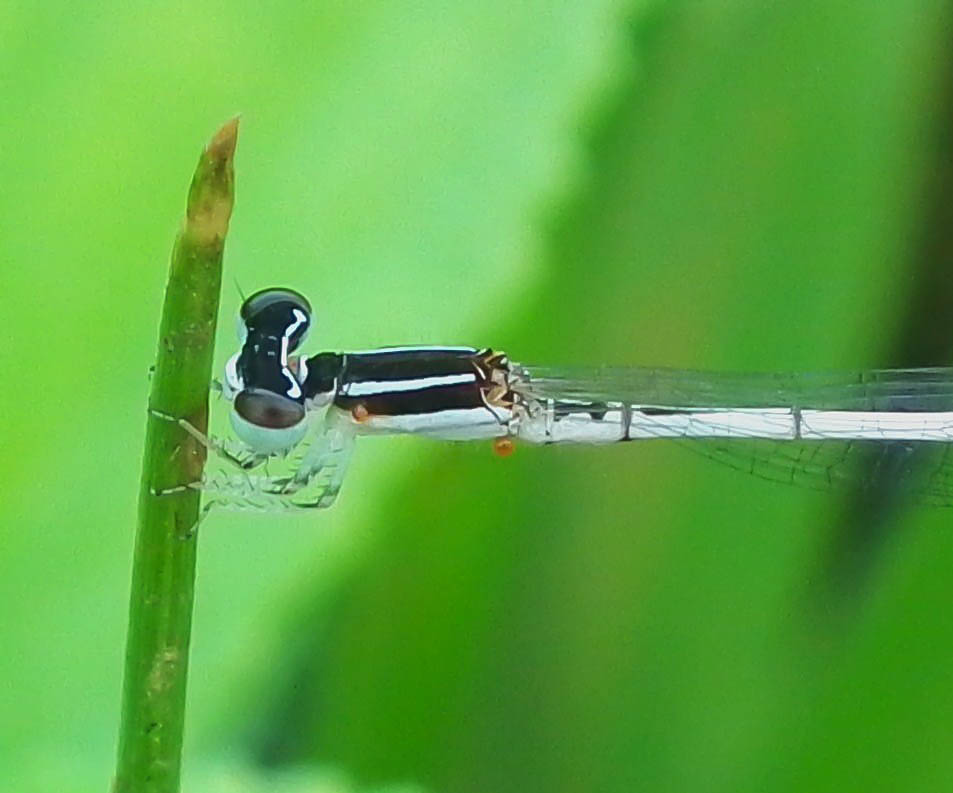
Agriocnemis lacteola Selys, 1877


Adule male resting on a spikesedge (Eleocharis), above a small marshy pool.

Agriocnemis lacteola can be easily found in flooded swampy fields, marshy edges of pools. But you really have to look closely for this little bugger as it is so small. 
 

For the identification, I used the “The Fauna of British India, including Ceylon and Burma” of Fraser (1933).
With its almost completely creamy white abdomen contrasting with the black thorax/occiput, the adult male is unmistakable. The face (labium and labrum) and the crescent-shaped post-ocular spots are also white.
The prothorax is black on dorsum, whitish at the sides ; posterior lobe is margined with white ; anterior lobe is creamy white.

The thorax is black on dorsum, with two narrow white antehumeral stripes. Pterostigmas are whitish/pale blue.
The dorsal marking on S2 is shaped like a vase, expanded at base with sometimes two parallel long branches (see second photo above).
S3 has a narrow mid-dorsal stripe. S4-10 are milky white.

Sub-adult male
  The immature male is not described in “The Fauna of British India”. Compare to the adult, the main difference is the color pattern of the dorsal thorax and the humeral stripe, which are both gray-brown and not black. 
 Sub-adult male. The thorax hasn't yet its ink black color pattern.

Adult male/Below : sub-adult. 

 But depending on the level of maturation, there are intermediate individuals, from light gray to almost black.
The same with the abdomen, which turn progressively from grayish to creamy white.

Adult female
The mature female differs rather widely from the male. It is a much stouter insect, and the first time I saw it, I thought it was a different species !
Post-ocular spots are crescent-shaped like the male but show an amazing azure blue color.
Thorax is similar to the male, but white has been replaced by bluish-green.
                                     The little things below the abdomen of this adult female
                                            are water mite larvae (Hydrachnidia, Acari).
The abdomen is also bluish-green, the dorsum of all segments rather broadly black, this expanding subapically on S2-6 and again narrowing to become confluent with the apical black ring.
I saw also a completely "blue" female, but I couldn't get a decent pic...

As Agriocnemis pygmaea and A. femina, the young female of A. lacteola is reddish.
Immature female
But it is easily identified by the pinky crescent-shaped post-ocular spots, the whitish pterostigma, the plain red brick thorax and abdomen (except the last segments more brownish) and the whitish anal appendages. 
This view from above of one immature female showing well the
crescent-shaped post-ocular spots and the pale anal appendages.

Agriocnemis lacteola is often found in disturbed habitats and is likely to be under-recorded.
This species occurs in India and Bangladesh, Nepal, Thailand, China (Fujian, Guangdong, Guangxi, Guizhou, Hainan, Henan, Hubei, Hunan, Jiangsu, Jiangxi, Sichuan, Yunnan, Zhejiang, Hong Kong), Vietnam (Laos, Cambodia?).

This tiny species seems to be fairly common in the agricultural lowlands around Hanoi, but it is easy to over-look unless you undertake searches..."the nose in the grass" ! 
I often spotted it in low marshy vegetation dominated by sedges (Carex/Eleocharis sp).

The agricultural plain of the North Vietnam (Red River delta) isn't really a paradise for dragonfly lovers - for bird lovers it is much worse : a BIG misery.
Poor odonata fauna but good enough for a beginner like me !

Hand-planting rice seedlings. 
A scene which remain unchanged for thousands of years.

06/10/2011

Pseudagrion microcephalum (Rambur, 1842)


The male of Pseudagrion microcephalum is often confused with P. australasiae. However, it has much longer superior anal appendages (visible from up to one meter distance if you have good eyes) and is - noticeably in my opinion - smaller  in size. 
And compare to its bigger cousin, it is a weaker flyer,... but that's just a birder's remark !

A male.


Anal appendages, lateral view                                                 Dorsal view

Superiors anal appendages black, blue within, as long as segment 10, deeply cupped within,  bifid at apex as seen in profile, with small  spines at the base on inner side; inferiors less than half the length of superiors, white, small cone-like.
According to Fraser (1933), microcephalum show considerable variation in appendages shape throughout its range, especially the superiors. 
The superior anal appendages is as long as S10 in microcephalum while they are only half that length in australasiae (for more details, see the post of this species). This is definitely the best feature to examine for a secure male identification. 

In Vietnam, other species more likely to be confused with it are, at least, Pseudagrion spencei and a Pseudagrion sp. nov. not yet described, both with males marked quite similarly on the thorax. These 2 species have been found in 2013 in northern Vietnam by Tom Kompier. The former is likely quite common (largely overlooked) ; the latter has been discovered in November at Huu Liên Natural Reserve (110 km north from Hanoi).

The males of these 3 species are very similar and need to be examined in hand and identified using a combination of structural characters (caudal appendages) and general maculation pattern. For more details, please consult Tom’s blog (odonatavietnam.blogspot.com).

A pair in copula. 

The female differs in several respects from the male, especially the thorax : bluish-green , richly suffused with golden orange on dorsum, especially in the humeral area, azure blue laterally.

A supposed immature female.


Pseudagrion microcephalum has a wide distribution from both Orient and Australasia. Recorded from western, northern and eastern Australia , China, including Guangxi, Guangdong, Hainan, Jiangxi  and Taiwan, India, Burma and Sri Lanka, Ryukyus in Japan, Bangladesh, Indonesia, Laos, East Malaysia, Peninsula Malaysia, Thailand and Vietnam. 

I bumped into this damselfly from time to time in ponds or along grassy banks of slow moving streams.