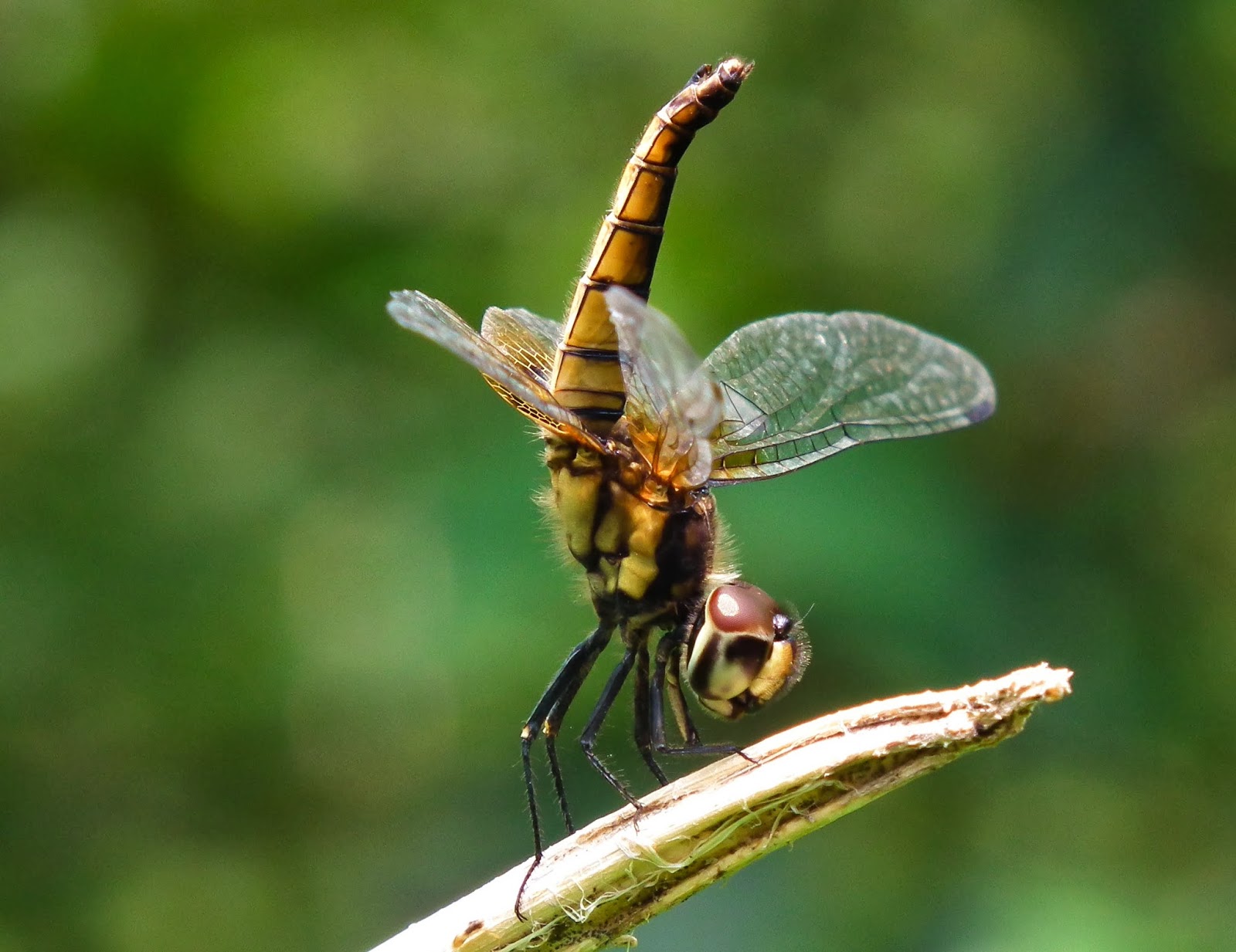
I often spotted females & immatures males Pseudothemis zonata aggregate for foraging in a small group, flying back and forth under tree cover, not far from the water's edge, exploiting small surfaces, and occasionally landing on branches... but just for few seconds !
The white-banded male also engenders lots of frustration for the poor odonata lover who try desperately to shoot the "beast". This vigorous flyer can often be seen patrolling rapidly and defending its territory, but almost never landing ! However, at few occasions, I was lucky enough to cross paths with one good guy perching restfully.

Male in flight. The white abdominal band really stands out.
The adult male has a deep black abdomen (S4-10) with a striking white band on S1-3. The frons is also white.
Both male and female show brownish wings tips (Pseudothemis jorina have entirely hyaline wings except a blackish patch at the base of the hindwings - which is also present in zonata).


The female can be also easily identified, even when she is flying, by the striking yellow band which encircles S1-3. But be careful, the immature male is very similar, and you will have to wait - it can take time... - they land on branches to identify with certainty the sexes.

Females (photo above and bellow)

The best way to tell the sexes apart is to closely examine the anal appendages. The female have divergent superior appendages (photo below), the male have closely apposed and strictly parallel ones.
The other obvious difference is the yellow band on abdomen : completely yellow in the male - it will become white with maturation -, with a dark ring in the middle in the female.


Male immature (pic above and bellow). Note also the proeminent yellow frons.

 |  |
Female ovipositing in a floating stick.
Pseudothemis zonata is a Sino-Japanese species found in China, Japan, Korea and Vietnam (north only ?). In Vietnam, it is replaced further south by the Indo-Malayan Pseudothemis jorina, a very similar species.
I spotted this species at many lowland locations around Hanoi, even within the city limits (so low quality water bodies), mostly at ponds surrounded by trees and shrubs but also at sluggish streams.