Affichage des articles dont le libellé est Libelluliidae. Afficher tous les articles

02/10/2013

Tramea virginia (Rambur, 1842)


Tramea virginia is a quite large libellulid characterized by very large basal patches to hind wings (obvious even in flight). This late season species can be seen (in my area) from August to November-December.

This male visually track a prey.

Tramea typically have bases of hind-wing more or less broadly marked with a large or irregular opaque spot. In fly, this creates the impression of them carrying bags; hence they are commonly known as “saddlebags gliders”!


A male viewed from above, showing well its famous “saddlebags”. This shot has been taken in mid-November with my old megazoom camera bridge (an interesting concept for a “polyvalent naturalist”, but once you have tasted a DSLR camera, you forget it quickly... Nevertheless, if sharpness is the least of your concerns, it remains a great tool). 

Another male, posed upon release. I didn’t choose the best support. Tramea loves twigs, not leaves! But a leaf is a more comfortable place for recovering...

Tom Kompier recently found the wind blown vagrant T. transmarina euryale at the marsh of Van Long in northern Vietnam (Ninh Binh Province). This is the first record of this species for the country. The most obvious differences between transmarina euryale and virginia concern the hindwings markings (notably reduced in transmarina, extending distally to distal end of discoidal cell and involving nearly whole of anal loop in virginia) and the secondary genitalia (hamules slightly overlapping the genital lobe in transmarina, markedly longer than lobe in virginia). The latter feature is obvious even on perched individuals – if you have binoculars!

Close-up on the secondary genitalia. 
Note the very long hamulus, greatly overlapping the genital lobe - three years ago I thought these things were penis and testicles :))


Tip of abdomen, male, lateral and dorsal views. 
Cerci very long, as long as the last three segments of abdomen.

The female is similar to male in head/thoracic colour pattern. Apart sexual characters, the most obvious differences between sexes are the colour of abdomen (amber-brown in the female, bright brick-red in the male; the last three segments are black in both sexes) and the basal marking on hind-wing (amber-yellow reticulation in the female, red in the male).
Anal appendages nearly as long as in the male, black, straight, very narrow.


The female above was caught as she was flying above a recently harvested rice field, in company of many Pantala flavescens. Both are great gliders! 
Many Tramea species engage migratory flight, but not to the same extent as seen in Pantala ; during the flight of the latter a good proportion of specimens of Tramea are to be seen accompanying them. All Tramea spp. appear to be physically adapted for gliding flight, and thus potentially for migration, by virtue of their broadly expanded hind wings, and extreme vagrancy (Michael L. May, 2012).

What the heck is that? If you answer “her eggs”, it is time to immerse yourself in the anatomy of Odonata! No, these bugs are water mites larvae. For more details about these ectoparasites, click here (an excellent post on Jim Johnson’s blog).

Female, posed upon release. Again, not the best support!


Spot in hind-wing very large, extending distally to distal end of discoidal cell and involving nearly whole of anal loop. Within this mark, the reticulation is amber-yellow in the female (left), bright red in the male (right), well defined against the dark background.


 Vulvar scales of great size, deeply cleft into two keeled processes, rounded at apices.


T. virginia is known from India, Myanmar, Bangladesh, Nepal, China, Taiwan, Japan, Korea and Vietnam. There is a single old record from Thailand.
I spotted it at ponds, marshes, often in human altered habitats. It is probably a fairly common species, but surprisingly I had few photo opportunities.


Due to its strong migrating power, Tramea basilaris is likely to appear as vagrant in Vietnam (apparently already recorded).

24/07/2013

Sympetrum hypomelas (Selys, 1884)


Many tour groups and independent tourists travel from Hanoi to Sa Pa (Lao Cai Province, northwestern Vietnam), principally to visit this picturesque mountain town (at 1650m a.s.l.) and its bustling market, where many of minority ethnic groups gather.

From a naturalist’s point of view, however, the journey’s highlight is a chance to visit the Hoang Lien National Park, which covers 25.000 ha in the Hoang Lien Son Range. This granite formation is the southeasternmost extension of the Himalaya Range. Much of it lies above 2000m, with a number of peaks reaching 2500-3000m, including the Mount Fan Xi Pan, the tallest mountain in Vietnam - and even in Indochina - at 3143m.

In this area, fauna and flora show Sino-Himalayan affinities - the Himalayan Libellulid Sympetrum hypomelas is a good example.


A pair at an ovipositing spot. The male flies above the female and drives away 
other males who may want to mate with her.

These shots of Sympetrum hypomelas were taken at Hoang Lien National Park in August, at 1900m, at a small marsh surrounded by forest.
This is a handsome black, yellow and red Libellulid - a very striking colour combination!

A pair in tandem

Male with labrum, face, frons suffused with bright red. Pterothorax reddish on dorsum, with a broad black humeral stripe; laterally two broad bright citron-yellow stripes separated by a broad black stripe. Wings hyaline, with extreme bases amber-yellow. 

 A resting male
Abdomen bright reddish above, black beneath, this colour overlapping on to sides from segments 2, 3, or 4 and very broadly so from segments 6 to 10.  

Female adult
Female closely resembling the male, but pterothorax golden-brown on dorsum, face amber and markings of abdomen very different than those of male : there is an additional subdorsal broad black stripe extending from base of segment 2 to segment 7, where it becomes confluent with the black of underside and enclose a yellow stripe.


Female not fully mature : abdomen not yet reddish above

A newly emerged female

Sympetrum hypomelas is a widespread species found in eastern India, Nepal, China (Tibet), northern Thailand (Loei, Chiang Mai), Myanmar and Bangladesh.

To my knowledge, this attractive Libellulid is a new record for the Vietnamese fauna.
 
The site where these shots were taken. The other species spotted in this area include, amongst others, Ceriagrion fallax and the rare Cordulid Somatochlora dido - the latter at the edge of the swamp forest (on the right).

 Sa Pa (1650 a.s.l.), in the North-West Vietnam highlands. This  hill-station town lies in the Hoang Lien Son Range, southeasternmost extension of the Himalaya Range. 
This area is made up of mid- and high-elevation forests, scrub and grasslands.


In this area, the avifauna also shows strong Sino-Himalayan affinities.
Photo : a stunning male Green-tailed Sunbird (Aethopyga nipalensis).

31/07/2012

Zygonyx iris Selys, 1869


I spotted many times this large libellulid along swift rocky streams, including those in open and agricultural land, in lowland and montane. The adult males hawk over a limited beat over rivers, generally over a rapid or below a waterfall. But they almost never land! And when they finally perch, they do not tolerate close approach…


Getting a good shot of this species is really difficult; but one day, you will probably bump into a tame individual that will accept what all the other ones have always refused : to be approached less than 1 meter. It happened to me.


The adult male has broad dark metallic greenish-blue stripes on thorax. Abdomen black, with mid-dorsaI carina finely yellow. Tips of wings enfumed.


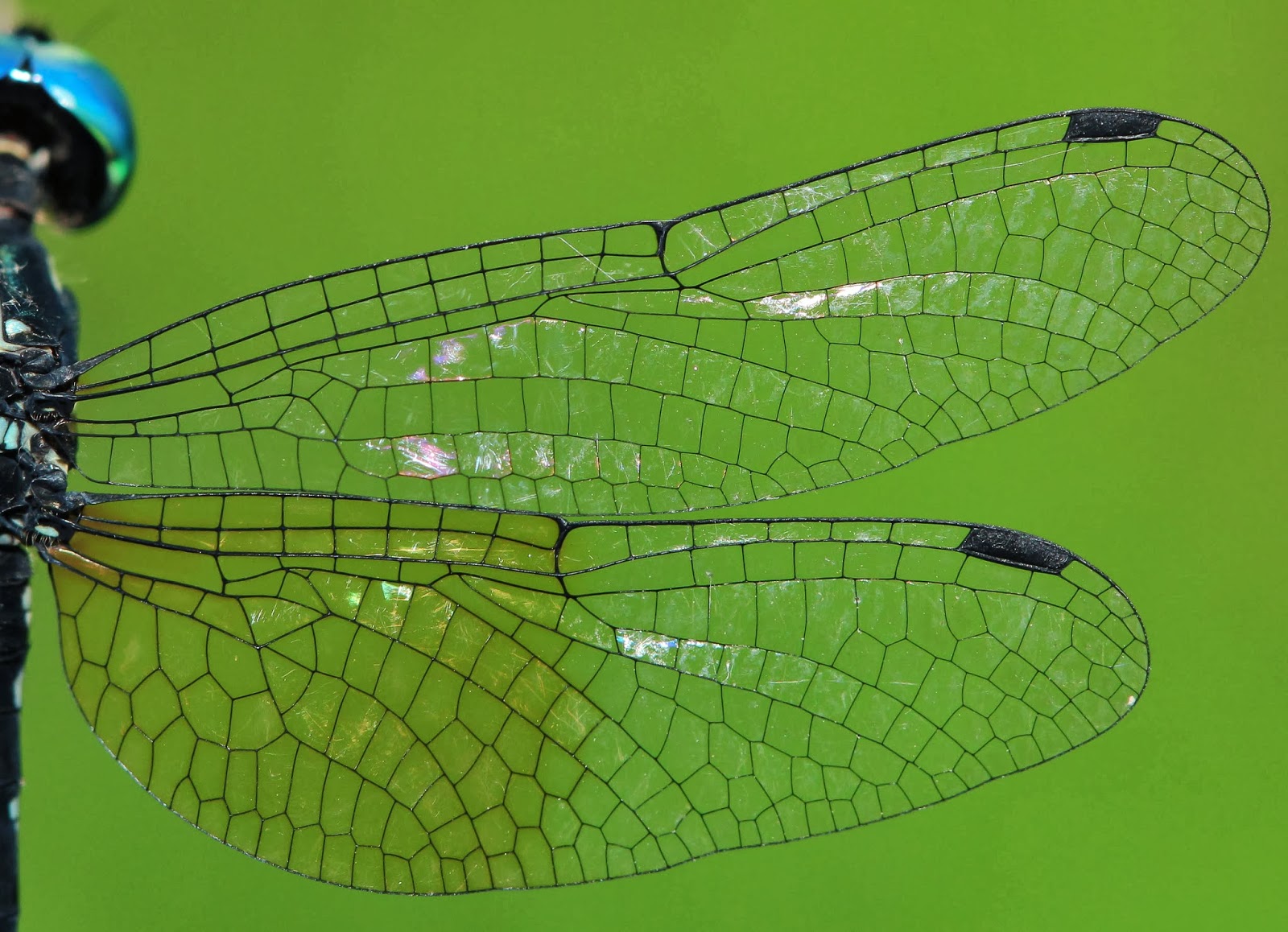
Close-up on wings.

Head : frons dark metallic blue

Female (photo below) resembles the male but the lateral yellow markings on abdomen (segments 1 to 3) are more extensive, and the thorax has broad yellow stripes (the immature male also).
Male and female pair over water and travel in tandem for great distances up-stream seeking suitable situations to deposit the eggs. The larvae are adapted, by a flat limpet-like abdomen, to cling to rocks.

  A female ovipositing by dipping her abdomen tip quickly into shallow water. To get some good close-ups of the female, no other solution than to capture her with a net during mating or oviposition. The rest of the time, she is invisible.

A female perched - a rare sight!

Zygonyx iris is a widely distributed species, occurring from northeast India to southern China and south to Borneo. It is a common species over much of its range.


Remarks: Another Zygonyx species occurs in Vietnam . Z. asahinai Matsuki & Saito, 1995 
This species is known from southern and eastern China (Fujian, Guangdong, Guangxi, Zhejiang) and has been recorded in very few localities in northern Vietnam (Mau Son mountain in Lang Son Prov., Tam Dao NP in Vinh Phuc Prov., at least). 

Z. asahinai resembles Z. iris in general appearance but can be readily distinguished from the latter by the following characteristics (from Matsuki & Saito, 1995) :

1. Labium entirely black in aged stage
2. Antehumeral yellow stripe very narrow and short, both infraepisterna darkened entirely
3 ♀wings yellowish orange tinted in the basal one-fourth
4. Different configuration of male accessory genitalia and caudal appendages
5. Different configuration of valvula vulvae


26/07/2012

Tetrathemis platyptera (Selys, 1878)


Tetrathemis platyptera is a very attractive libellulid that I have spotted on a few occasions above stagnant waters, often very small forest pools.


With its emerald-green eyes, bronze-green reflection on thorax, it is a very “photogenic” dragonfly.


The adult male has stunning blue eyes and a metallic green thorax marked broadly with yellowish stripes. 


The wings are hyaline, but the hindwings are faintly tinted with yellow. According to Fraser in The Fauna of British India, including Ceylon and Burma – Odonata (1933), the depth of the colour depends partly on the age of the specimen and partly on the locality, some showing a very intense amber tint, others with no colouring at all, especially teneral specimens.


The abdomen is black, marked with spots (lateral ones from S1 to S4-S5, which decrease in size and length from segment to segment; dorsal basal spot(s) on S7; remaining segments unmarked).


Wings, male. 

 A male caught by a wolf spider.


Female (2 photos below) almost similar in markings to the male, but the abdomen spots are larger, the wings show a much richer and deeper tint of amber.


Her abdomen is also much stouter.
I saw the female briefly, mating and ovipositing immediately after.

Copula.

The female deposits her eggs on branches or leaves overhanging water, from whence the newly hatched larvae drop into their future habitat. One day, I have seen a mass of eggs deposited on a dead branch, 30 cm above the water (watch this scene of oviposition in the video below).

A female on the branch where she will soon begin to oviposit. The male is hovering in close proximity (blue spot in background) to guard the oviposition site and prevent harassment by other males.

                                                                                       Oviposition in action.

Tetrathemis platyptera is widely distributed in tropical and sub-tropical Asia, with records from India, Myanmar, Thailand, Laos, Vietnam, China, Peninsular Malaysia, Java and Sumatra (+Cambodia, Bangladesh?).
According to some authors, this is a rather local species over much of its range, but probably under-recorded.

The place were all these photos were taken : a small pond in degraded forest, at the lower slopes of Tam Dao. Other species breeding there include Coeliccia scutellum, Orolestes selysi, Polycanthagyna erythromelas, Orthetrum triangulare, O. chrysis, Zyxomma petiolatum.